




|
Background The Community Renewables Initiative (CRI) supports community-led renewable energy projects, providing an alternative means to help with the regeneration of localities. CRI is a partnership initiative funded by DEFRA, DTI, Countryside Agency and the Forestry Commission. Aims The aim of the CRI is to help communities to plan and implement renewable energy projects which help to enhance the sustainability of local regeneration. Activities There are currently 10 Local Support Teams (LSTs) across England delivering the Community Renewables Initiative. Severn Wye Energy Agency (SWEA) is responsible for managing both the National Co-ordination Programme and the Local Support Team for Gloucestershire, South Gloucestershire and Wiltshire Services offered by SWEA LST under the CRI Under the CRI Severn Wye Energy Agency offers free impartial advice to community groups on renewable energy including: Information on the different renewable energy technologies Advice on setting up a project Information on how to finance a renewable energy project Project development support The CRI also works with local decision makers to develop local policies and strategies for renewable energy. The following projects have been supported by the Local Support Team provided by SWEA: Brockweir and Hewelsfield Community Shop
With the closure of the village Post Office and general store the local people in the two villages of Brockweir and Hewelsfield were finding they had to travel long distances to Chepstow and Monmouth for basic services. The community decided to get together and build their own community shop. An Industrial and Provident Society was established and a community bond scheme has allowed local people to invest in the project. Heat is supplied via a 12kW ground source heat pump and under-floor heating system with heat taken out of the earth beneath the adjacent playing fields. Electric power required to run the heat pump is supplied from a 4.5kW roof-integrated solar photovoltaic shingle system. As the shop is in the Wye Valley AONB the installations are designed to be of minimal visual intrusion proving that renewable energy can work in the most sensitive of landscapes.
The shop sells locally produced food to reduce food miles and also houses a library kiosk, a volunteer run café, an IT training suite and an office for a local company.
SWEA provided advice on the technologies that would be best suited to the building and advice on potential sources of funding for the renewable energy aspects of the shop.
The heat pump and photovoltaic array together offset approximately 4 tonnes of carbon dioxide annually.
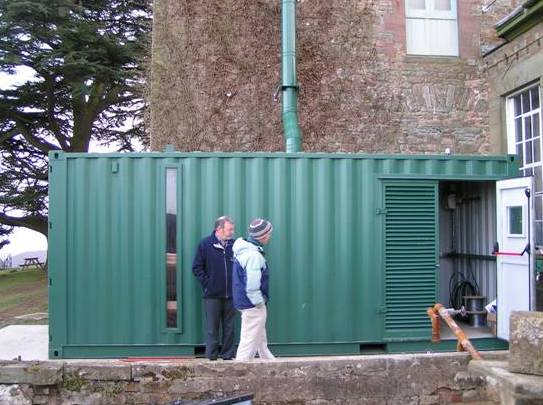
The Wilderness Environmental Education Centre The Wilderness Environmental Education Centre on Plump Hill near Mitcheldean has installed a state-of-the-art 100kW wood pellet fired heating system. The fully automated boiler system will burn wood pellets to provide heat for the centre which offers a range of residential and day courses in Environmental Education, Outdoor Education and Personal and Social Development. The system will burn around 32 tonnes of wood pellets every year, offsetting the use of around 15,000 litres of oil that would otherwise have been used to heat the Centre and reducing CO2 emissions by 43 tonnes per annum.
The centre has also installed a 2.73kW solar photovoltaic array. The system consists of 34 mono-crystalline modules arranged in a 24m2 array.
It is expected to generate 2,040 kWh per year, which will offset 877.2 kg of CO2 in terms of grid electricity replaced. This adds up to 21.8 tonnes over 25 years (the guaranteed lifetime of the system).
Funding was obtained from the DTI Major Photovoltaic Demonstration Programme. This provided 50% of the cost with the remainder of the funding coming from Gloucestershire County Council and the EDF Green Energy Fund.
|
Key points Seeks to enhance sustainability of local regeneration projects by including renewable energy installations SWEA manages the National Co-ordination Programme as well as the Local Support Team for Gloucestershire, South Gloucestershire and Wiltshire
|
|
To find out more contact
Kierson Wise, Project Manager Tel (01594) 545368 E-mail: [email protected] Severn Wye Energy Agency Ltd 6/15 The MEWs Brook Street Mitcheldean Gloucestershire GL17 0SL Other related projects |